Sublime landscape paintings have played a significant role in art history, from the majestic heights of the Renaissance to the intense swirls of 19th-century Romanticism and the innovative approaches of contemporary artists. These artworks blend beauty, drama, and destruction to evoke strong emotions. Philosopher Edmund Burke, in his 1757 work *A Philosophical Enquiry into the Origin of Our Ideas of the Sublime and Beautiful*, described the sublime as beauty mixed with danger, fear, or horror. He defined it as “whatever is in any sort terrible or is conversant about terrible objects or operates in a manner analogous to terror,” deeming it the most intense emotion the mind can experience. This compelling idea has fascinated artists for centuries.
Sublime landscapes, marked by their dramatic and emotional qualities, have long been a favorite subject in art. Even before Burke’s influential text, artists depicted swirling storm clouds, sharp cliffs, and jagged, snow-covered peaks to inspire awe and terror. Here are some of the most striking examples of sublime landscape paintings from the Renaissance to modern times.
1. Pieter Brueghel the Elder, Landscape with the Flight into Egypt
Pieter Brueghel the Elder’s Landscape with the Flight into Egypt (1563) epitomizes the sublime in Northern Renaissance landscape painting, merging breathtaking scenery with a religious narrative. Mary and Joseph are tiny figures navigating a treacherous cliff in the foreground, fleeing persecution in Bethlehem. The landscape mirrors their journey: the pale, distant scenery represents the familiar land they are leaving, while the dark, ominous foreground symbolizes the unknown dangers ahead. Brueghel skillfully contrasts stillness and motion, portraying the rocks and mountains as steadfast and unchanging, against the constant flow of water, people, and birds. This balance between darkness and light, fragility and permanence, stillness and movement, makes this painting a lasting image of the sublime.
2. Philip James De Loutherbourg, An Avalanche in the Alps
Philip James De Loutherbourg’s An Avalanche in the Alps (1803) captures the sublime during a time when the French Alps were a popular symbol of picturesque danger. De Loutherbourg, a British-based, French-born painter and theatre set designer, infused his canvases with dramatic lighting, depth, and movement. In this painting, the French mountains begin to collapse into an avalanche, sending clouds of dust and smoke billowing across the scene and obscuring the sky. A flash of white light in the center highlights the tiny, terrified onlookers, who appear insignificant against the overwhelming forces of nature poised to engulf them.
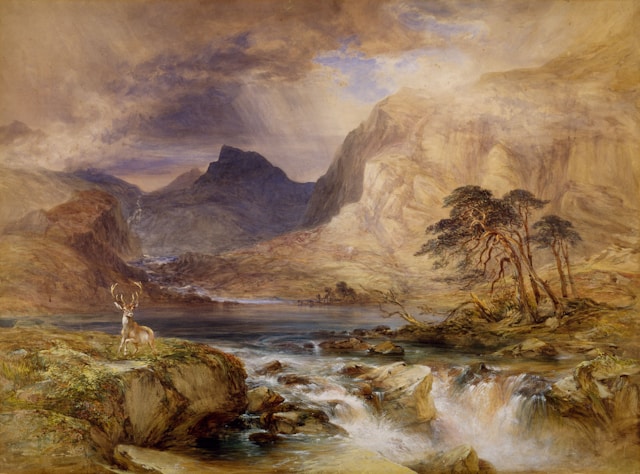
These sublime landscapes not only enhance the visual appeal but also invoke deep emotional responses, continuing to captivate viewers and artists alike through their powerful representations of nature’s grandeur and peril.